
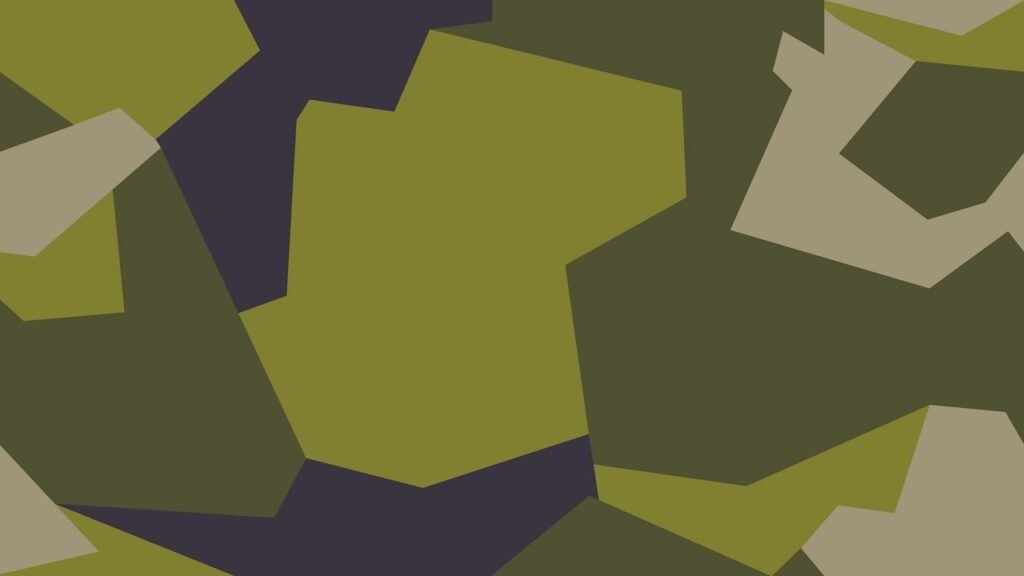
The Swedish M90 is a splinter pattern of enormous straight edged shards in four flat colours, scaled down from a camouflage designed for tanks and aircraft. It is still Sweden’s standard pattern, nicknamed “Lövhögen”, the leaf pile, by Swedish soldiers, which is ironic for a design with no curves in it at all.
| Country | Sweden |
|---|---|
| Pattern type | Four colour geometric splinter pattern |
| Introduced | With Field Uniform System 90, in service from the late 1980s |
| Status | Current standard pattern of the Swedish Armed Forces |
| Colours | Four: dark green, medium green and a very dark shade on a light beige ground |
| Used by | Swedish Armed Forces, all services |
Design
Very large angular polygons with straight edges and flat colours: no dots, no flecks, no curves and no rain strokes. The “shattered glass” geometry is intended to break up the silhouette at relatively long observation distances in Scandinavian forest and mixed terrain, rather than to blend at close range, and the shapes are far larger than in German Splittertarn or any fleck pattern. The darkest shade is usually described as black with a high blue content that fades to dark navy, chosen, one research institute expert explains, because natural shadows appear blue to the human eye; some Swedish sources dispute that blue was ever a component and describe the colours as three greens plus black. The four colour count itself is not in dispute. Variants keep the same geometry in other colours: the desert M90K, the tropical M90TR, the light M90L and winter versions.
History
Sweden was a latecomer to camouflage uniforms, wearing plain olive through most of the Cold War, and the M90’s breakthrough came from vehicle camouflage research, not uniform design. In the 1970s the Defence Research Establishment (FOA) developed a four colour splinter camouflage for vehicles, installations and aircraft, most famously the Saab 37 Viggen’s “Fields and Meadows” scheme. In the 1980s FOA scaled that vehicle pattern down by a factor of roughly 1:66 to fit a human torso, adjusting it for the naked eye and binoculars rather than aerial photography. Uniform development began in 1982, with trials in about twenty units in the mid 1980s; troops were photographed wearing the pattern by 1989, the Field Uniform System 90 was formally established on 19 February 1990, and the pattern was adopted across the whole Swedish Armed Forces by the late 1990s. Although it sits in the same hard edged splinter family as Splittertarnmuster, the documented development is this indigenous FOA lineage, not a descent from the German pattern. The design was not protected by the Swedish state until October 2020, when a registered version added small scattered three crowns symbols as its only change, so it spread widely onto commercial products in the interim. It is being carried into Sweden’s new Nordic Combat Uniform systems, and Swedish special forces additionally adopted MultiCam in 2016 for interoperability with NATO forces.
Identification notes
Against German Splittertarnmuster 31: M90’s shapes are dramatically larger, its palette is only four flat colours, and it has no rain strokes and none of Splittertarn’s small splinter detail. Against Flecktarn: Flecktarn is small rounded dots; M90 is large straight edged shards, with no curves anywhere. Against Danish M/84: M/84 is a flecktarn style spot pattern; M90 is angular polygons. Against its own variants: M90K keeps the identical geometry in sand, brown and grey desert tones; the standard pattern is always the green, beige and dark scheme.
Related patterns: MultiCam, Flecktarn.
Swatch image: LEJK, CC BY-SA 4.0, via Wikimedia Commons. The image is a seamless recreation of the Swedish M90 woodland pattern.