
After the Second World War, rebuilt Czechoslovakia dressed its army partly in a home produced copy of the German Sumpftarnmuster, the soft edged marsh pattern Germany had introduced in 1943. The Czechoslovak version kept the German three colour scheme and blurred shapes, and it served until Czechoslovakia’s own vz.60 mlok pattern arrived in 1960.
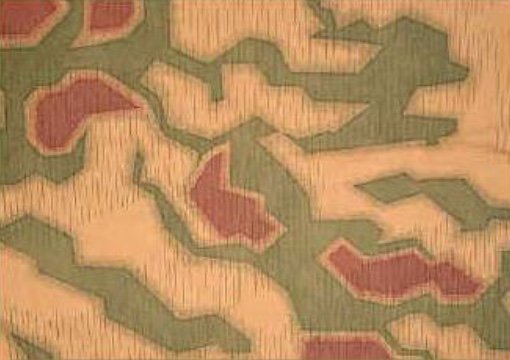
| Country | Czechoslovakia |
|---|---|
| Pattern type | Three colour marsh (swamp) disruptive pattern |
| Introduced | Postwar, after 1945 (exact issue dates are not firmly documented) |
| Status | Retired, replaced by indigenous Czechoslovak designs from 1960 |
| Colours | Reddish brown and dark green overprints on a tan ground |
| Used by | Czechoslovak Army |
Design
The pattern follows the German Sumpftarnmuster layout: large, open marsh shapes in reddish brown and dark green over a tan or dark beige ground, with the diffused, blurred edges of the later wartime style rather than the hard geometry of Splittertarn. It is the Sumpfmuster 44 character, softened and more saturated, that the Czech print follows. The German 1943 version also carried thin overprinted rain strokes inherited from Splittertarn, and whether a given Czech print carries them depends on the wartime model it follows. Surviving references associate the Czechoslovak copy mainly with shelter halves and tent sheets and with limited clothing use, rather than with a general issue uniform, and documentation of these early postwar Czechoslovak patterns is thin.
History
Germany issued Sumpftarnmuster from 1943, on smocks, helmet covers, winter overpants and other items, mainly on the Eastern Front. Czechoslovakia emerged from the war with major textile printing capacity, and its rebuilt army adopted a local version of the marsh pattern in the early postwar years. The record is muddled: one camouflage compilation describes Czechoslovakia’s first postwar pattern as a local version of the German Leibermuster instead, so references to Czech copies of German wartime patterns are sometimes conflated, and unattributed pieces should be treated cautiously. What is clear is the succession: the Sumpfmuster copy gave way to the indigenous vz.60 mlok “Salamander” in 1960, followed by a 1965 splinter type, the 1980s raindrop pattern, and eventually the vz.95 after the country split.
Identification notes
Three colours with soft, blurred edged marsh shapes on a tan ground separate this family from Splittertarn, whose shapes are hard and angular. Against the West German BGS Sumpfmuster: the BGS versions kept prominent rain strokes, used their own colour shades, and are marked as German federal property. Against genuine German wartime Sumpftarn, separation rests on production details, stamps and shade differences that are not reliably documented, so treat unattributed cloth with care.
Related patterns: Bundesgrenzschutz Sumpfmuster, Third Design, SS-Erbsenmuster.
Swatch image: ThePickleGambit, CC BY-SA 4.0, via Wikimedia Commons. The image shows the German Sumpfmuster 43, the wartime original the Czechoslovak pattern copied; no freely licensed image of the Czechoslovak version itself is available.